
A research team led by Profs. WU Zhikun and ZHUANG Shengli from the Hefei Institutes of Physical Science of the Chinese Academy of Sciences, in collaboration with Professor LU Zhou from Anhui Normal University, has proposed an instant "anti-galvanic reduction" alloying strategy for the synthesis of large silver nanoclusters.
The results were published in National Science Review on January 10.
Metal nanoparticles exist in two forms: molecular nanoclusters and metallic nanocrystals. However, determining the critical size at which this transition occurs has long been challenging. Conventional synthesis methods often suffer from poor stability, uneven sizes, and low yields for highly reactive silver clusters in particular, restricting both basic research and practical use.
In this study, the researchers used the unique anti-galvanic reduction behavior of silver nanoclusters to trigger alloying with zinc. Control experiments showed that zinc clusters cannot form independently and require the presence of silver clusters. This strategy significantly improved cluster stability and enabled the production of large quantities of uniform silver-based nanoclusters, representing a substantial improvement over previous methods.
The researchers further applied a precise "atomic surgery" dealloying technique to selectively remove zinc atoms while preserving the overall structure, successfully producing pure silver nanoclusters. Structural characterization revealed that both the alloyed and pure clusters share a stable, well-defined crystal framework.
Although these nanoclusters display strong absorption features similar to metallic nanoparticles, advanced spectroscopic measurements confirmed that they remain molecular in nature rather than truly metallic. This result shows that commonly used steady-state absorption spectra may lead to misleading conclusions, while ultrafast techniques are a more reliable way to judge metallic behavior.
The ability to prepare high-quality nanoclusters in large quantities also allowed the researchers to explore their photothermal properties. The researchers found that, compared with both smaller clusters and larger nanocrystals, nanoparticles near the critical size exhibit enhanced light absorption and photothermal conversion efficiency.
"Our work overcomes long-standing challenges in the stable, large-scale preparation of reactive silver nanoclusters," said Prof. WU Zhikun, "It also provides a reliable way to distinguish molecular clusters from metallic nanoparticles and reveals the unique properties of nanoparticles at the critical size, paving the way for future research and applications."

Summary diagram of atomic-scale manufacturing and characterization of Ag-based nanoclusters (Image by FANG Liang)

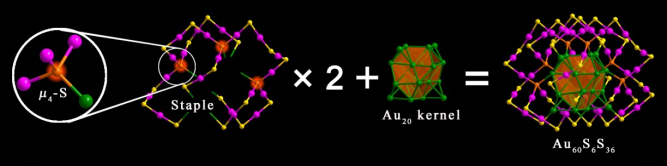
Very recently, Chinese researchers found a crystallographic closest packing-6H left-handed helical arrangement, which represents a novel crystallographic closest packing since the report of the third one (4H arrangement) that found in bulk Ag in 1979 (the first two are we...

86-10-68597521 (day)
86-10-68597289 (night)

52 Sanlihe Rd., Xicheng District,
Beijing, China (100864)
Copyright © 2002 - Chinese Academy of Sciences


